
On the job
Safe Lifting for CNAs: Protect Your Back
Patient handling is the biggest cause of muscle and joint injuries in health care. Here is what the safety research says and how to move residents safely.
By the CaregiverCert team · Updated October 24, 2026 · 6 min read
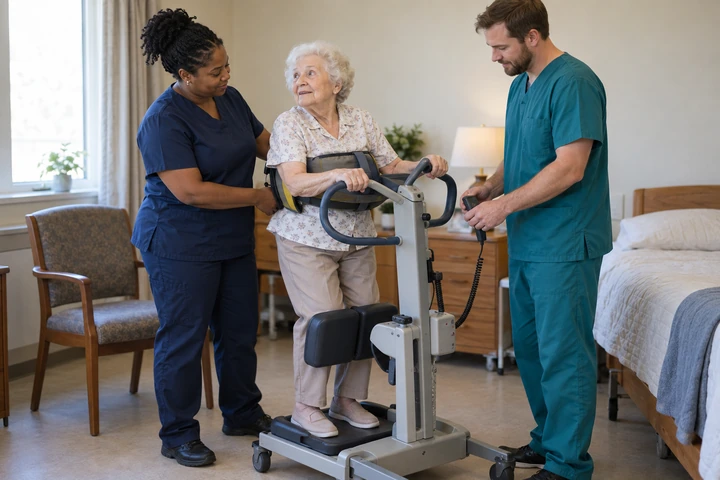
Nursing assistants have one of the highest rates of injuries and illnesses of any occupation, according to the U.S. Bureau of Labor Statistics. Much of that comes from lifting, turning, and transferring residents. The good news: many of these injuries can be prevented.
Why manual lifting is so risky
The National Institute for Occupational Safety and Health (NIOSH) calls patient handling the single greatest risk factor for musculoskeletal injuries among health care workers. People aren’t shaped like boxes: they can shift, resist, or suddenly lose their balance, and you often have to reach or twist to move them.
The numbers back it up. In 2018, nursing assistants had 15,360 musculoskeletal injury cases that required days away from work, and these made up 52 percent of all their days-away injuries, according to BLS.
How much weight is too much?
NIOSH research (Waters, 2007) found that even under ideal conditions, with a cooperative resident, about 35 pounds is the most a caregiver should lift by hand during patient-handling tasks. Above that, assistive devices should be used. NIOSH authors have since stressed that this is a research finding, not an official legal limit, and real conditions are rarely ideal.
In practice, that means almost every full transfer of an adult should involve equipment or extra help.
Use the equipment
OSHA recommends that manual lifting of residents in nursing homes be minimized in all cases and eliminated when feasible. Common equipment includes:
- Full-body sling lifts for residents who can’t bear weight, used with two or more caregivers.
- Sit-to-stand (stand-assist) lifts for residents who can bear some weight and cooperate.
- Lateral sliding aids and friction-reducing sheets for moving a resident in bed or between surfaces.
- Height-adjustable beds so you can work at waist level.
- Gait belts for steadying and guiding a resident while walking. OSHA says gait belts should not be used to lift residents.
Your training covers transfers and assistive devices, and federal rules require it in every CNA program. If you aren’t sure how to use a lift, ask for training before you use it.
Body mechanics that help
- Check the resident’s care plan for how much help they need, their size, whether they can cooperate, and any medical conditions.
- Raise the bed to waist height, and lock the wheels on beds and wheelchairs.
- Keep the resident close to your body, with your feet apart for a stable base.
- Avoid bending and twisting. Turn your whole body by moving your feet.
- With a gait belt, use a rocking and pulling motion rather than lifting.
- Tell the resident what you’re doing and count together, so you move as a team.
- Ask for help. Never do a two-person transfer alone because you’re short on time.
If you get hurt
Report any injury to your supervisor right away, even if it seems minor, and get it checked. Reporting protects you and helps your workplace fix the problem. Repeated strain from small injuries is how many back problems start.
Frequently asked questions
What is the maximum weight a CNA should lift?
NIOSH research found that about 35 pounds is the most a caregiver should lift by hand during patient handling under ideal conditions. Above that, use a lift or other device. This is guidance, not a legal limit.
Can I use a gait belt to lift a resident?
No. OSHA says gait belts should not be used for lifting residents. They’re for steadying and guiding.
What is the most common injury for CNAs?
Musculoskeletal injuries, such as back and shoulder strains from lifting and moving residents.
What should I do if there's no lift available?
Get help from another staff member, tell the nurse, and don’t attempt an unsafe lift alone. Report equipment problems to your supervisor.
Keep reading
- NIOSH, Safe patient handling and mobility
- Waters TR, When is it safe to manually lift a patient? (2007)
- Galinsky and Lu, Revisiting the limits of the 35 pound limit (2016)
- OSHA, Guidelines for Nursing Homes: Ergonomics for the Prevention of Musculoskeletal Disorders
- U.S. Bureau of Labor Statistics, Musculoskeletal disorders fact sheet
- U.S. Bureau of Labor Statistics, Occupational Outlook Handbook: Nursing Assistants and Orderlies