
Getting started
Is CNA Training Hard? An Honest Look
The material isn’t college-level, but it asks a lot of you in other ways. Here is what to expect, and who tends to find it hardest.
By the CaregiverCert team · Updated October 24, 2026 · 6 min read
Short answer: for most people, CNA training is very doable. You don’t need a science background, and programs are built for beginners. What makes it challenging isn’t the reading. It’s the hands-on skills, the physical work, and the pace of a short program. Here is an honest breakdown.
How much training is required
Federal rules set the minimum at 75 hours, including at least 16 hours of supervised practical training with real residents or clients (42 CFR 483.152). Before you work directly with residents, you must complete at least 16 hours on communication, infection control, safety and emergencies, residents’ independence, and residents’ rights.
Many states require more. California requires 160 hours, Missouri 175, and Maine 130 or more. A longer program usually means more practice, not harder material. See how long CNA training takes for typical schedules.
The classroom part: easier than most expect
Classroom topics include basic anatomy, infection control, safety, residents’ rights, communication, nutrition, and how to recognize changes in a person’s condition. The reading level is similar to a high school health class. If you keep up with the assigned reading and quizzes, most people do fine.
The skills part: where the real work is
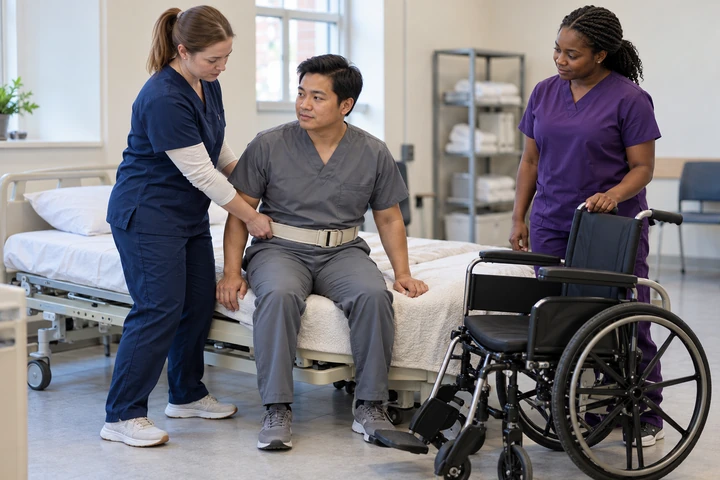
You’ll learn and practice skills like hand washing, taking vital signs, transferring a person from bed to wheelchair, making an occupied bed, giving a bed bath, feeding, and range-of-motion exercises. Each skill has exact steps, and the state exam scores you on those steps. The challenge is memorizing the order and doing it smoothly while talking to the person you’re caring for.
Clinicals: the part people find hardest
During clinicals, you work with real residents in a nursing home or hospital under a nurse’s supervision. For many students, this is the hardest part, for reasons that have nothing to do with grades:
- Physical work. You’re on your feet, lifting, turning, and bending for hours.
- Personal care. Helping people bathe and use the bathroom takes getting used to.
- Emotional moments. Residents may be confused, in pain, or near the end of life.
Most students say clinicals are also when they find out they love the work.
The state exam
To get certified, you pass a written (or oral) test and a skills test. The written test is multiple choice and covers what you learned in class. In the skills test, an evaluator watches you perform a few randomly chosen skills. Federal rules guarantee you at least three tries. If you’re worried, read what happens if you fail the CNA exam.
Tips to make it easier
- Practice skills out loud at home, step by step, until you can do them without the checklist.
- Take the free 50-question practice test before the exam.
- Wear comfortable, supportive shoes from day one of clinicals.
- Ask questions. Instructors expect beginners.
- Learn proper body mechanics early to protect your back.
Frequently asked questions
Is CNA training harder than medical assistant training?
They’re different. CNA programs are usually shorter and focus on hands-on personal care, while medical assistant programs are longer and include more clinical and office tasks.
Can I do CNA training while working full-time?
Often, yes. Many programs offer evening or weekend classes. Clinicals may have set hours, so ask before you enroll.
Do I need to be good at math or science?
Not really. You’ll do simple measurements, like intake and output in milliliters and vital signs, but no advanced math or science.
What is the hardest part of CNA training?
For most students, it’s the clinicals and memorizing the exact steps of each skill for the state exam.